St. Lucia’s traditional pottery can be seen any day in the Castries Market on sale for locals and tourists alike…but the truth is that it is a highly endangered craft.
In the days when many more homes did not have the convenience of a gas stove, the ‘coalpot’ was in use on many a kitchen’s back step – perhaps even two or three were used to cook up the food for the day. But progress makes its changes and today, the demand for these items has dwindled.
But it’s not just the lack of customers for these products that ails this tradition – the craft of making traditional pottery is itself about one of the most hard physical labour intensive things you could choose to do…and to boot, these beautifully simple utility crafts are made in even simpler unassuming huts and sheds on the potters’ lands. These characteristics of the craft have the unfortunate result that not one single child of the existing potters is interested in continuing in the craft.
This is a tradition in danger of imminent loss. I am involved in a couple of projects within which we will attempt to change this – but I can’t say I have a huge amount of confidence as I feel that this will require quite a lot beyond the scope of these projects. We hope to reduce the hard labour, promote the value of the tradition, make ways in which the items can more easily be transported off island by tourists and bridge tradition and contemporary tastes and ways, to encourage the younger generation into keeping the tradition alive, if even with some modern adaptations. Now I know that has it’s pros and cons…but in my mind, there is always space for ‘live’ traditions and by their nature, they must fit into the lives of those who carry them on – otherwise they are historical traditions – each has it’s place.
Ok, I know a fair amount about this craft, but I don’t pretend to be an expert; my friend of many years Patricia Fay, currently Assoc. Professor of Art at Florida Gulf Coast University though, has spent the last 15 years coming down to St. Lucia again and again, studying and working with our traditional potters; she has travelled the Caribbean and been to Africa to compare the pottery traditions.
So, I’ll give you a brief introduction into the world of our traditional pottery here and at the bottom of the article you can follow links to more information from Tricia.
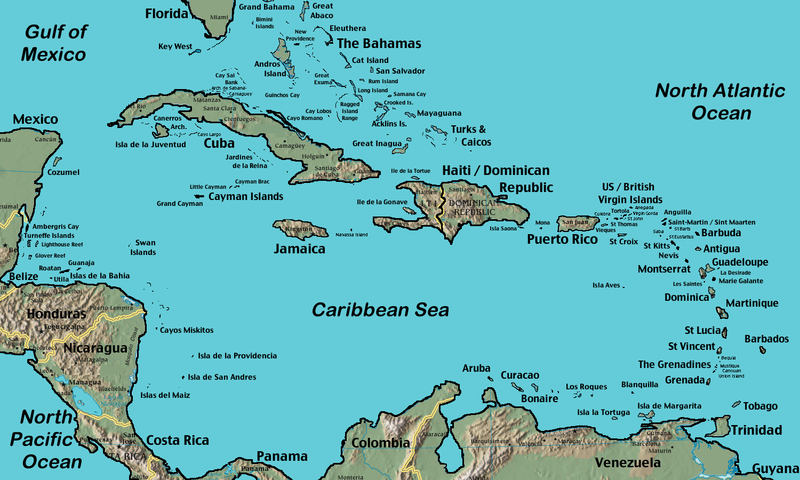
St. Lucia’s traditional pottery is made from clays dug on the land of the potters; this land lies in the shadow of Gros Piton, on the slopes of the hills and valleys of Choiseul – Morne Sion, Matin, Fiette, La Pointe. This is a craft of women…I believe there is 1 solitary man who makes pots, but really, it is a women’s craft. The whole family may help in digging the clay – suitable spots are located and a pick-axe used to break through the top soil to the clay underneath.
 |
| Irena Alphonse digging clay at Cathy Osman's Land |
This is then carried to where it will be slaked with water and then mixed by pounding with a pestle on a flat rock. At this stage, some potters will mix different clays together to create the clay they find works best for them. As each potter works from their own patches, the clays used can be quite different in colour, strength, smoothness, with some resulting in better products than others.
 |
| One of the FGCU students gives pounding the clay a good try |
The clay itself is a young clay with a high level of montmorillonite in it; this has the effect of making it very plastic and strong in the wet and greenware stages but it is not normally associated with a ‘good’ clay body as it tends to cause deformation if not fired carefully (correct me if I am wrong on this, I am working from memory here!) The beauty of this clay and the products made from it is that they are highly resistant to thermal shock; this is in part also due to the coarsness of the clay body – equivalent of a highly grogged clay. The coalpot is used with coals lit directly in its bowl and in the full tradition, the cooking pot – the canawi , chaudier/ chodye (pronounced shod’yay) or leshwit (pronounced lee-schweet) would be placed directly on top of those coals without the risk of cracking. The food cooked in this way is unlike any cooked in a steel or aluminium pot…the taste is just not the same!
Another traditional form is the Cawaf – the water jug – again, because the clay remains porous, the water partially evaporates when in the Cawaf – cooling as it does.
Other uses of coalpot and leshwit are to ‘parch’ (pronounced pach) coffee – the clay holds the heat of the fire so well, the coffee beans roasted this way, once again, have a special flavour to them.
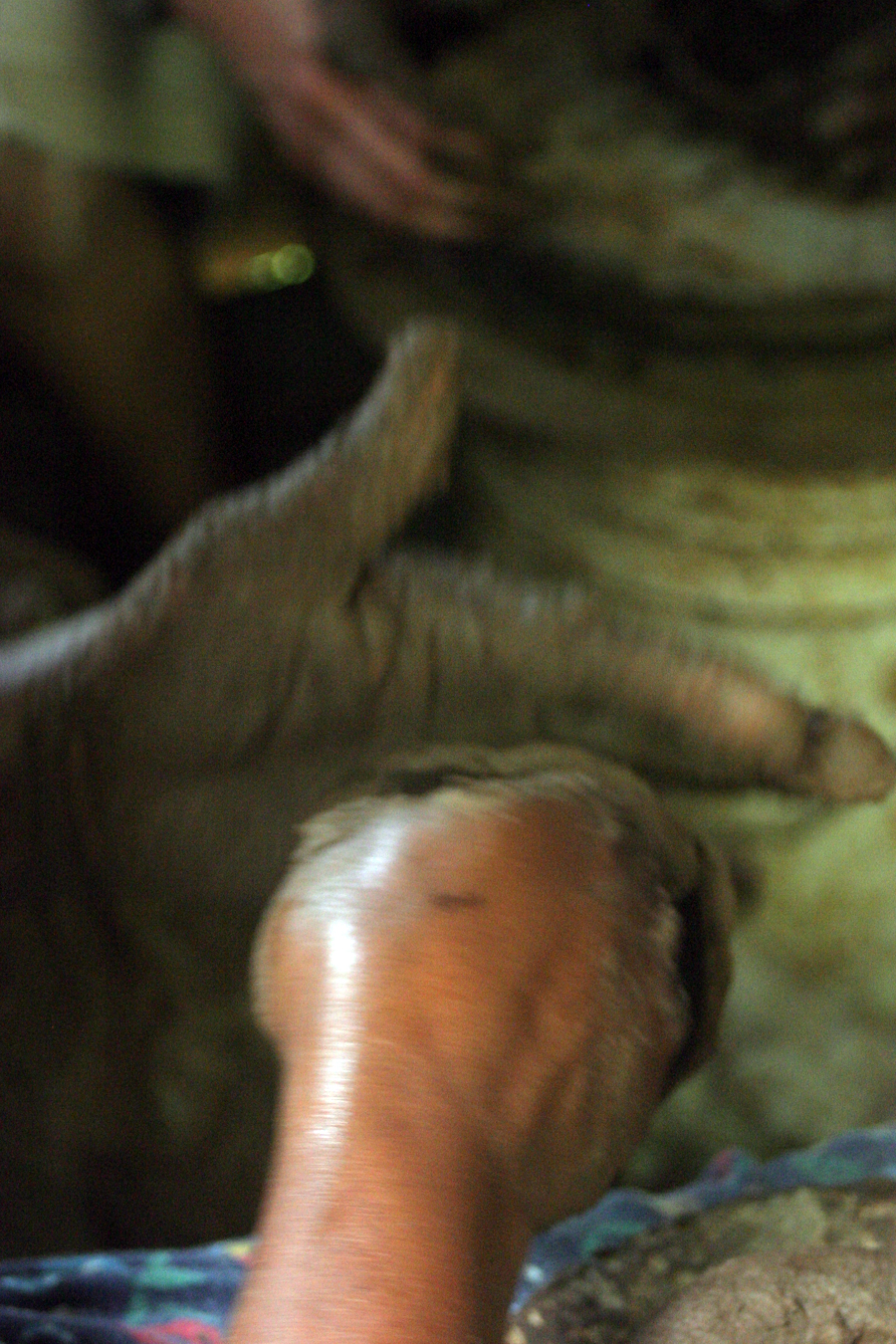
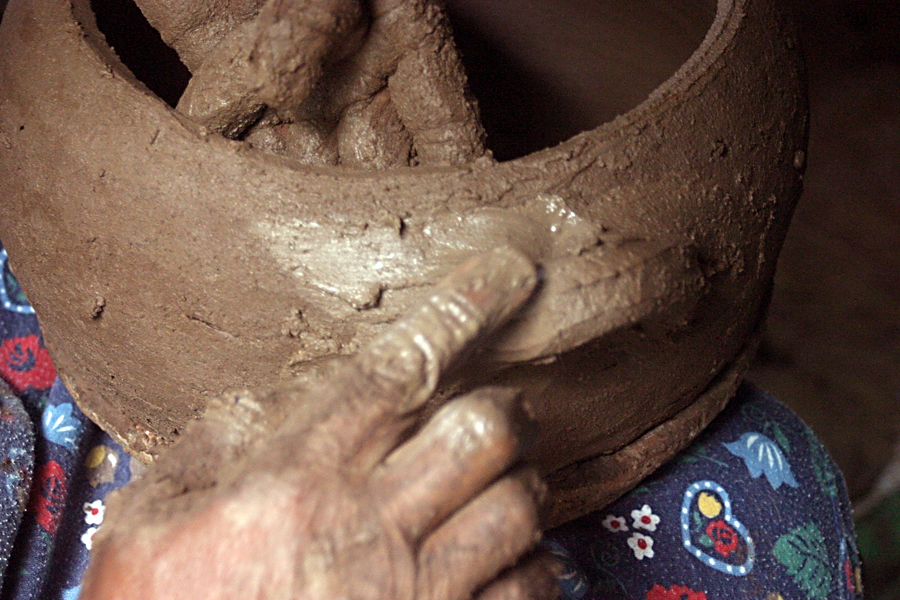
The making of a coalpot and all the other forms is done by a method very similar to one that I first learnt from African potter Magdelene Odundo who visited us at Crewe & Alsager College when I studied there; large soft coils are rapidly shaped by blending them ‘as you go’ into each other. Sides and shape are adjusted with hands during the coiling stage and adjusted with ribs afterwards. Edges smoothed off with a damp cloth.
 |
| Irene Alphonse making a coil to start a Canawi |
 |
| Irene shaping the start of a bowl shape for a canawi |
|
|
 |
| Irene and Cathy working |
|
|
|
|
 |
| Cathy finishing the base section of a coalpot |
 |
| Irene shaping the inside of a canawi with a calabash rib |
 |
| Cathy working on the base of the coalpot |
 |
| Cathy adds a handle to the nearly finished coalpot base |
 |
| Irene adds a handle to the nearly finished canawi |
 |
| both the coalpot and canawi are nearly done |
 |
| Irene Smooths the rim of the canawi |
 |
| Cathy smooths the rim of the coalpot |
Pots are left to dry very slowly – 2-3 weeks. They are then scraped with river stones to give them a final smoothing. In the original tradition, the pots are carefully and knowledgeably stacked in the open at the firing spot – wood, coconut, etc is placed strategically in, around and over the pile and it is lit to the windward and burnt through. This requires a certain combination of weather conditions and so, often the firing has to wait. Part of Tricia’s work has been to build brick kilns for the potters – largely broadening the weather that firings can take place in and increasing the heat and evenness of the firing too. The local business Clay Products Ltd, owned by Geoffrey Devaux, has been instrumental in these projects, donating bricks for all the kilns built so far.
 |
| Finishing the building of a fully traditional firing - Irene & Cathy (Photo courtesy of FGCU) |
 |
| The end of the firing (Photo courtesy FGCU) |
 |
| The newest kiln built by the FGCU team under Patrica Fay's guidance (Phtoto courtesy of FGCU) |
So, where does that leave us? This tradition is special – at the time of writing, latest figures show a drop in the number of active potters; where a few years ago, you could count up to 50, the largest traditional pottery by far in the Eastern Caribbean, today there are a scant 30 or less. And no daughters...or sons, looking to follow in this tradition. This tradition will be lost if we can’t find ways to regenerate it. All help is welcomed.
 |
| A finished Coapot and Canawi |
For further reading:
As always, your comments, thoughts, suggestions, memories and all are what completes these posts - please do share them and share the post with others too!
Finola








 ShareThis


 Posts
Posts

